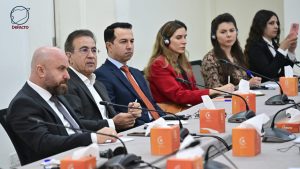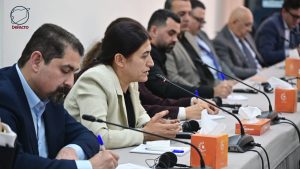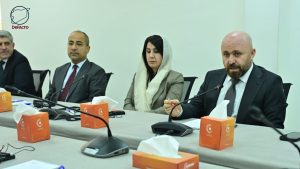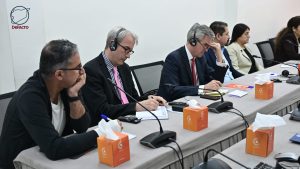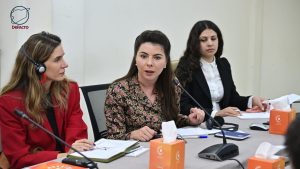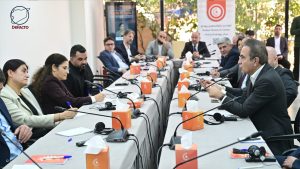

The Rudaw Center for Studies, in cooperation with DeFacto Dialogue Platform, organized a discussion session on Sunday at its headquarters in Erbil, capital of the Kurdistan Region. The session addressed the latest political developments in Syria and was attended by officials, researchers, and Western diplomatic representatives.
The session hosted Elham Ahmad, Co-Chair of the Department of External Relations of the Autonomous Administration of Northeast Syria, alongside Rohilat Afrin, a commander of Women’s Protection Units. Participants included representatives of research centers, journalists, academics, as well as delegates from the U.S., British, and German consulates in Erbil.
Ahmad spoke about the mechanisms for implementing the January 29th agreement between the Syrian Democratic Forces and the Syrian transitional government, as well as the political and military challenges related to the integration file. According to participants, she stressed that any integration process should be based on the principle of partnership within the Syrian state, rather than dissolution or the elimination of local particularities. She emphasized the importance of constitutionally guaranteeing Kurdish rights, adopting the Kurdish language as a language of instruction, and preserving the distinct character of Kurdish-majority areas by ensuring they are administered by their local populations.
For her part, Afrin addressed the challenges related to restructuring military forces, particularly the future of Women’s Protection Units, in light of ongoing political transformations. She stated that any forthcoming security arrangements should take into account the specific experience established in Northeast Syria.
Participants also discussed developments concerning the Kurdish issue in light of regional and international shifts, relations between Syrian Kurds and the Kurdistan Region of Iraq, and prospects for enhancing dialogue and joint coordination in the coming period. These discussions come amid efforts to find a balanced formula between the existing realities in North and East Syria and the requirements of the transitional phase at the level of the Syrian state.