
Chalang Omar*
The geopolitical and economic importance of Syria’s coastal region lies in it being the country’s only outlet to the Mediterranean Sea. This significance has grown amid the evolving energy dynamics—particularly natural gas—among the countries bordering the Eastern Mediterranean. The presence of this vital resource introduces dynamics that could shape Syria’s position within regional and international alignments. Moreover, it is expected to elevate the coastal region’s role and status within Syria’s internal landscape in the years to come.
Two Decades of Competition over Eastern Mediterranean Gas
Over the past two decades, the Eastern Mediterranean Basin—including the Levant and the Nile Delta—has attracted growing regional and international attention due to its substantial natural gas reserves. The U.S. Geological Survey estimates that the basin holds more than 300 trillion cubic feet of natural gas off the coasts of Syria, Lebanon, Israel, Egypt, Cyprus, and Turkey, in addition to approximately 3.5 billion barrels of crude oil.
While these figures may not rival the massive reserves of Russia or Qatar, projections indicate the potential for further discoveries. The reserves already uncovered are sufficient to meet domestic demand in the region and offer valuable export opportunities. This has incentivized European countries to engage with the Eastern Mediterranean energy equation in an effort to diversify energy sources and reduce dependency on Russian gas.
With the initial discoveries of gas fields in the Eastern Mediterranean, especially off the coasts of Egypt, Cyprus, and Israel, a race against time began among coastal states to explore and extract gas. European and American energy companies were quick to join the competition. Geological reports indicate that the gas is located at relatively shallow depths throughout the basin, meaning that whoever begins extraction first stands to secure not only their share but potentially encroach on the reserves of neighboring coastal states.
These gas discoveries have triggered geopolitical and military tensions among some Eastern Mediterranean countries. Naval warships have occasionally been deployed to escort exploration vessels or to intercept those of rival states. The gas basin has become a point of contention due to unresolved disputes over the demarcation of EEZs and continental shelves. Several countries have not ratified the United Nations Convention on the Law of the Sea (UNCLOS) of 1982 and 1994, choosing instead to bypass international maritime law in favor of bilateral or multilateral agreements to delineate maritime borders and facilitate exploration and extraction.
In recent years, tensions have intensified between two opposing camps vying for control over the Eastern Mediterranean’s gas wealth. On one side are the member states of the East Mediterranean Gas Forum (EMGF), established in 2019 and headquartered in Cairo. Its members include Egypt, Cyprus, Greece, Israel, Jordan, Italy, France, and the Palestinian Authority, with the United States participating as an observer. On the other side stands Turkey, which has stepped up its activities against its rivals—chiefly Greece and Cyprus—through drilling operations in the waters of “Northern Cyprus,” a breakaway entity recognized only by Ankara, and through a memorandum of understanding signed with Libya’s Government of National Accord in Tripoli. This agreement disregarded the presence of Greek islands that Athens considers part of its sovereign maritime domain.
Syria in the Eastern Mediterranean Gas Equation
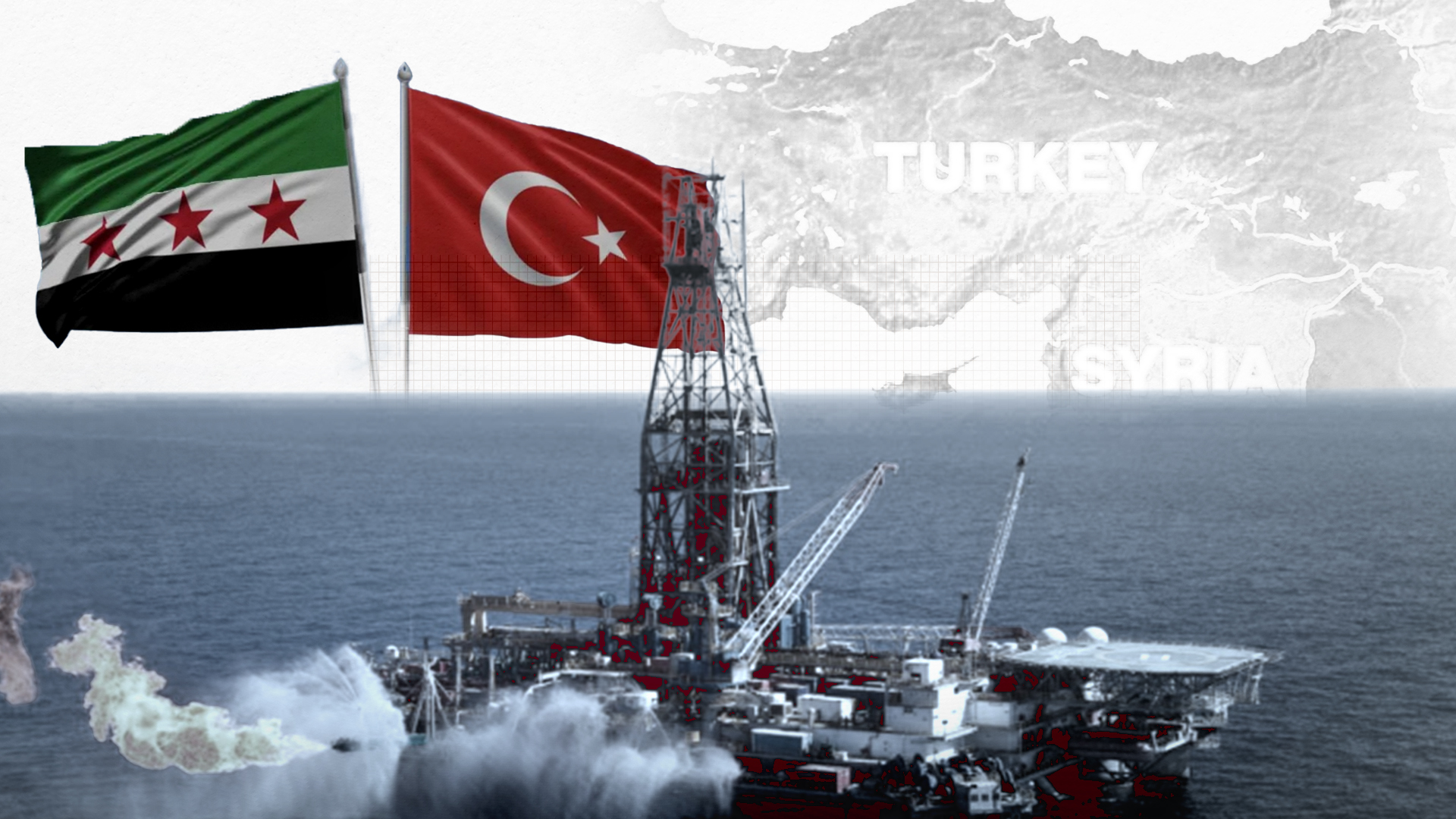
For years during the war—since 2011—Syria remained outside the regional competition over gas in the Eastern Mediterranean. However, only a few weeks after the collapse of the Ba’ath regime and the flight of Bashar al-Assad at the end of last year, Turkish officials rushed to announce Ankara’s intention to demarcate maritime borders with Syria and sign agreements with the new government in Damascus regarding gas exploration in Eastern Mediterranean waters.
This Turkish haste to formalize agreements with Damascus before the situation stabilizes adds a new layer of complexity to the Syrian landscape and its regional and international extensions. The new Syrian leadership is an interim government, and there are divergent political and legal views on whether it holds full authority to enter into treaties and sign agreements with foreign parties, particularly in strategic matters. This recalls a similar move by Turkey in 2019, when President Recep Tayyip Erdoğan signed a maritime border demarcation agreement with Fayez al-Sarraj, head of Libya’s Government of National Accord. That deal exacerbated internal Libyan divisions and fueled greater competition between Turkey and other Eastern Mediterranean coastal states.
From Ankara’s perspective, concluding a maritime border agreement with the Damascus government—formed under the auspices of Hayat Tahrir al-Sham (HTS), with which Turkey maintains close relations—would serve to consolidate Turkey’s maritime influence and shift the balance of current energy dynamics in the region. This could include securing Damascus’s recognition of Turkey’s claims in the EEZs of “Northern Cyprus”—a self-declared state recognized only by Turkey that lies opposite the coasts of Ankara’s regional rivals—or gaining access to Syria’s own EEZ in the Mediterranean. For Turkey, this represents a strategic opportunity to establish a new foothold in the Eastern Mediterranean and potentially form a regional alliance that includes Damascus, Tripoli, and Northern Cyprus. Such an alliance would allow Ankara to challenge its rivals in the EMGF, particularly Cyprus and Greece, and bolster its ambition to become a regional hub for natural gas transport to Europe.
However, Turkey’s efforts to bring Syria into its fold and reshape the region’s energy map face resistance from other influential players. On one hand, there is the EMGF, comprising several countries—each wary of Turkey’s expanding role and influence in Syria generally, and on its coast in particular. On the other hand, there is Russia—the world’s largest gas producer and holder of the biggest reserves—which maintains a military presence on the Syrian coast and has its own strategic calculations regarding the gas sector.
Israel, which has long sought to curb the influence of Iran and Hezbollah in Syria and Lebanon, as well as Hamas in Gaza, is concerned about the rise of extremist Sunni groups on its northern borders and the emergence of a government in Damascus aligned with Turkey. Such a development would not only threaten Israel’s security interests but could also undermine its economic ambitions. Israel aims to be part of the “economic corridor” linking India to Europe via the Gulf and the Eastern Mediterranean. When it proposed the formation of the EMGF, Israel envisioned becoming a regional hub for energy exports to Europe. To that end, it has signed several agreements in recent years related to gas transportation and electricity interconnection with Cyprus and Greece.
As for Russia, even though Eastern Mediterranean gas does not pose a practical alternative to Russian gas or present real competition, Moscow is determined not to lose its near-monopoly over the European energy market. Russia has therefore asserted its presence in the Eastern Mediterranean gas arena—militarily, through its bases in Khmeimim and Tartus on the Syrian coast, as well as in eastern Libya, and economically, through Russian gas exploration companies. In doing so, Russia has sent a clear message: it remains a major player that cannot be sidelined, standing as a counterweight to both Turkey and the EMGF in the regional energy competition.
Syrian Gas on Land and at Sea
As with other countries bordering the Eastern Mediterranean—many of which have been extracting gas from their EEZs for nearly two decades—it is likely that Syria’s EEZ also contains significant gas reserves. While precise data on proven offshore gas reserves off the Syrian coast is lacking, estimates by the U.S. Geological Survey suggest that Syria’s maritime zone may hold up to 700 billion cubic meters of natural gas (1 cubic meter ≈ 35 cubic feet).
This estimated offshore reserve is roughly three times the amount of Syria’s onshore gas reserves, which stand at around 240 billion cubic meters. Before the war, Syria’s gas production averaged 28 million cubic meters per day, half of which came from associated gas. Approximately one-third of this output was reinjected into oil wells to enhance recovery, with the remainder used to supply power stations and produce Liquefied Petroleum Gas (LPG) for domestic use.
Syria’s gas fields are primarily located in the central, eastern, and northeastern regions of the country. Prior to the war, one-third of total gas production came from areas now controlled by the Autonomous Administration of North and East Syria (AANES), while the majority of the fields remain under the control of the central government. Today, national production has dropped to just 10 million cubic meters per day—insufficient to meet even half the demand of the country’s gas-powered electricity generation stations.
Syria began technical and legal preparations for offshore gas exploration in the early 2000s. The Syrian government signed contracts with foreign companies to conduct geological and seismic surveys in its territorial waters to estimate potential oil and gas reserves. These surveys covered approximately 10,000 square kilometers of Syria’s EEZ and yielded “promising results” regarding the presence of gas. Three offshore blocks were identified for exploration, located opposite the coastal cities of Latakia, Banias, and Tartus. However, despite calls for bids, exploration activities in these offshore blocks did not commence before the outbreak of war.
During the conflict, several Russian companies—such as Soyuzneftegaz and Stroytransgaz—secured contracts to explore and extract oil and gas in the Syrian portion of the Eastern Mediterranean basin. Yet these contracts have not led to actual production, mainly for non-economic reasons. Corruption allegations surrounded these deals and companies, compounded by the volatile political and security situation in Syria, as well as Western sanctions imposed on Damascus.
Challenges and Requirements
Syria’s maritime borders intersect with Turkey to the north, Cyprus and “Northern Cyprus” to the west, and Lebanon to the south, placing the country at the crossroads of fault lines in the Eastern Mediterranean gas equation. With a new ruling authority in Damascus, speculation is mounting over how Syria will position itself within this regional energy contest. However, the economic incentives and political motivations that may shape the new government’s alignment face both internal and external challenges.
There is no doubt that Syria’s entry as a player in the Eastern Mediterranean gas arena would shift existing regional dynamics. Aligning with Turkey and adopting Ankara’s vision for maritime border demarcation could open opportunities for Syria to exploit its coastal gas resources through partnerships with Turkey. This could help secure fuel and electricity critical to Syria’s economic recovery, and potentially allow gas exports via pipelines either to the Turkish market or through Turkey to Europe. However, such a move would likely challenge the EMGF and its member states—particularly Israel and Egypt—which could interpret Syria’s stance as siding with Ankara against them. It might also spark tensions with the Arab Gas Pipeline project, parts of which were completed in Syria before the war. Attempts to revive the project have faltered due to sanctions and the behavior of the former regime.
Alternatively, Syria could choose to distance itself from these regional rivalries by promoting broader regional cooperation and working to reduce geopolitical tensions through mutual interdependence. Instead of aligning solely with Turkey, Syria could engage with multilateral energy projects and form diverse partnerships. While Syria has not signed the United Nations Convention on the Law of the Sea (UNCLOS) nor delineated its maritime boundaries, ratifying the treaty could help safeguard Syria’s sovereign rights in its territorial waters and reassure neighboring states. This might also pave the way for future joint investments and production-sharing agreements in overlapping economic zones with Lebanon, Turkey, and Cyprus.
Achieving such a scenario, however, faces significant obstacles. Chief among them is the impact of Western sanctions on Syria, which hinder not only offshore gas exploration and extraction but also constrain nearly every sector of the Syrian economy, including oil and gas. Moreover, the new leadership in Damascus still seeks international legitimacy. Without completing the constitutional and legal frameworks necessary for Syria to sign maritime border agreements or accede to UNCLOS, the new authorities will remain unable to meaningfully enter the Eastern Mediterranean gas equation—rendering their efforts no different from those of the former regime.
There is also a list of demands and conditions tied to the transitional phase that interim President Ahmad al-Sharaa and his government must meet to demonstrate the legitimacy and representativeness of their governance, and to assure the international community that they pose no threat to regional security or the interests of neighboring states.
Further complicating matters, Syria’s participation in Eastern Mediterranean gas projects depends first and foremost on stabilizing the internal situation. The massacres carried out between March 7–10 by extremist jihadist groups and military formations affiliated with the Syrian Arab Army in Alawite villages and towns along the Syrian coast revealed the fragility of the security environment and the multiplicity of loyalties and centers of power within the new administration. Western governments have condemned the atrocities, which killed thousands of Alawite civilians, and raised concerns about the infiltration of foreign jihadist organizations into the new ruling structure.
Conclusion
Syria’s natural resources cannot be integrated into reconstruction and recovery efforts without a comprehensive political and constitutional process that grants the government domestic and international legitimacy. While the conditions for international recognition have been made clear by Western officials, domestic legitimacy hinges on forging consensus among Syrians around shared interests and fair distribution of power and resources—offering credible assurances about the nature of the new Syrian state.
The coastal region, which holds major economic importance as Syria’s gateway to the Mediterranean and due to its offshore gas wealth, must—like all other parts of Syria—be approached with a national reconciliation framework. Any unilateral attempt by the central authority to marginalize local interests or monopolize economic resources risks reigniting conflict and reproducing the very dynamics that led to the war. Such a path would ultimately harm Syria and the Syrian people as a whole.
* A writer and researcher specializing in economics and international relations.