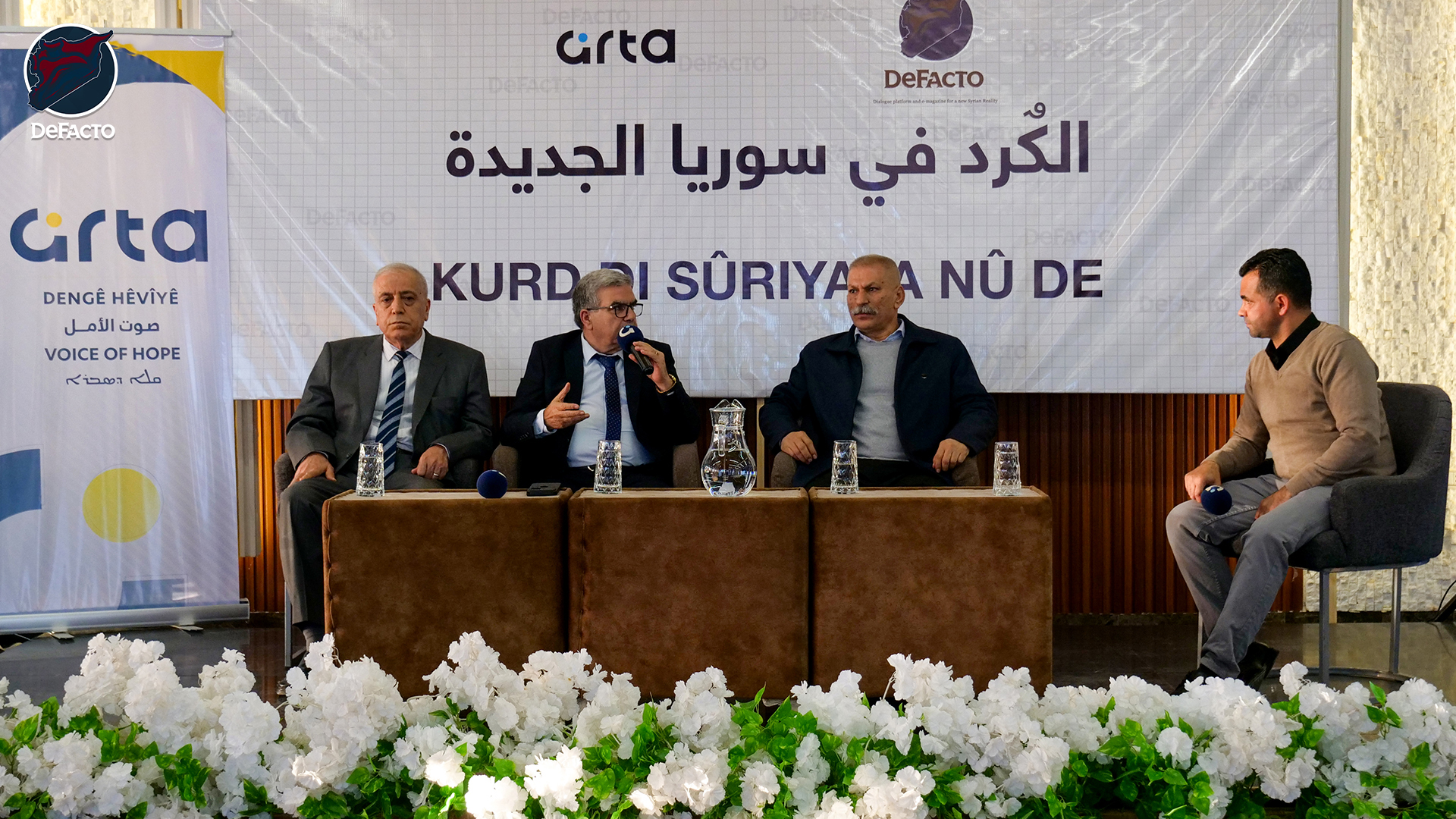
The DeFacto Dialogue Platform and the Arta Foundation for Media and Development organized a dialogue forum in Qamishli titled “Kurds in the New Syria: Challenges and Opportunities.” The forum resulted in several recommendations for Kurdish political actors.
Participants included officials from Kurdish political parties, civil activists, media professionals, and writers from the region, who presented various perspectives and suggestions for Kurdish political parties on navigating the post-Assad era.
Participants’ Contributions: A New Scene in Damascus
- The international community is monitoring the performance of the newly-formed government and the extent to which Hayat Tahrir al-Sham (HTS) adheres to its commitments.
- The situation differs from Iraq in 2003, where there was direct American rule. In Syria, even the United Nations has yet to intervene directly.
- To inspire confidence, residents of Aleppo’s Sheikh Maqsoud and Ashrafiyeh neighborhoods were treated like all other Syrians. The HTS’ position there was not antagonistic, but Turkey and the Syrian National Army (SNA) factions launched attacks aimed at causing confusion and division among decision-makers in northeastern Syria.
- The foundations of the democratic Syria we aspire to have not yet been established. The scene remains very unclear.
- The term “minority protection” is being discussed but lacks clear definition.
- Developments are moving rapidly, and even international actors are acting hastily. This requires swift action, as the current opportunities and conditions may not persist in the future.
Axis 1: Unifying the Kurdish Front and Strengthening Political Representation
- Resume the intra-Kurdish dialogue process, which previously made progress under the supervision of the Syrian Democratic Forces (SDF) commander and the international coalition.
- Open a new chapter to unify Kurdish political discourse with responsibility, avoiding exclusion or denial of each other’s struggles.
- Overcome internal Kurdish disputes by unifying independent Kurdish-Syrian political decision-making and aligning with the broader Kurdish position to support the Kurdish cause in Syria, which would benefit all of Syria.
- Form a unified Kurdish delegation to Damascus, representing political parties, intellectual leaders, legal experts, and media professionals. Separate, undisclosed delegations should be avoided.
- Clearly define the Kurdish project for a democratic, pluralistic, and transparent Syria that guarantees women’s rights and resolves the Kurdish issue domestically.
- Democratic solutions abound: federalism, decentralization, and drafting a constitution that guarantees solutions are viable paths.
- Understanding the government’s position on the Kurds requires dialogue in Damascus. If the government avoids discussing Kurdish issues, it risks accountability for failing its commitments.
- While readiness for dialogue and avoiding hostility are positive, some steps need caution. Kurds must seek solutions on their terms, as adversaries will always attempt interference.
Axis 2: Protecting the Achievements of the North and East Syria Project
- Safeguard previous achievements in North and East Syria and utilize them to support democratic goals in the new Syria.
- Maintain relations with Syrian communities and democratic forces.
- The risk of the country sliding back into authoritarianism or extremism threatens all Syrians, as does undermining coexistence among Syrian communities, which equally jeopardizes the Kurds.
- A fundamental factor for agreements includes coexistence, religious tolerance, and women’s rights, as committed to by the new authorities in Damascus. These align with the project of the Autonomous Administration.
Axis 3: Dialogue and Societal Initiatives
- Mobilize popular and political movements to contribute to shaping the new framework. Relying solely on external pressures will not guarantee change.
- Include social figures and intellectual leaders in consultations regarding the region’s future.
- Clarify the Kurdish position to local communities, emphasizing that all groups share a common destiny. Kurdish strengths, such as the SDF, the Autonomous Administration, and the Kurdish National Council, are not tools to act against other communities.
- Respond to initiatives countering calls to exclude Kurds or separate them from the broader Syrian populace.
Axis 4: Preparing for Political and Future Changes
- Strive to unify Kurdish and broader national political discourse concerning the shifts in Damascus.
- Elevate the fight against ISIS to a strategic level with long-term partnerships.
- Agree on addressing potential questions in Damascus, such as the relationship between the Autonomous Administration and the central government and providing reassurances to Turkey.
- The Kurdistan Workers’ Party (PKK), given its sacrifices in previous stages, should clarify its stance to protect the Kurds and the communities of North and East Syria.
- Maintain a Syrian national discourse and prioritize Syria’s future during this critical phase.
Axis 5: Media and Combating Hate Speech
- The Syrian regime’s security apparatus has spent years fostering hatred and instilling fear among Syrians. While Kurds have generally refrained from responding to hate speech, mechanisms to counter distortions and misinformation in communities and on social media must be strengthened.
- The Autonomous Administration must adopt transparency, informing the public about agreements and steps taken. Media strategies should accompany each development to prevent the spread of misinformation.
- Divisive rhetoric emerged from the perception that the removal of the regime threat diminishes the necessity for partnerships with Kurds and the Autonomous Administration. However, shared interests in coexistence and solutions for the national project demand continued collaboration.
- Improve media discourse to amplify Kurdish voices and explain their project to others. Previous communication strategies have fallen short of expectations.
- Enhance political discourse to adapt to current changes, emphasizing that Kurds are stabilizing forces amid the upcoming transformations.